On-the-Job Training: junior to mid-career NMHS professionals.
Secondment: mid-career NMHS professionals and experts involved in WMO programmes.
On-the-Job Training and Secondment Programme
About the programme
ACMAD's programme strengthens African meteorological experts in advanced operational methods and tools, scaling effective climate services from regional to national level through practical case studies and professional exchange.
The programme strengthens NMHS capacity for accurate weather and climate services by advancing forecasting, data management, early-warning and AI skills; supporting ACMAD-NMHS product co-production; and building a continent-wide practitioner network.
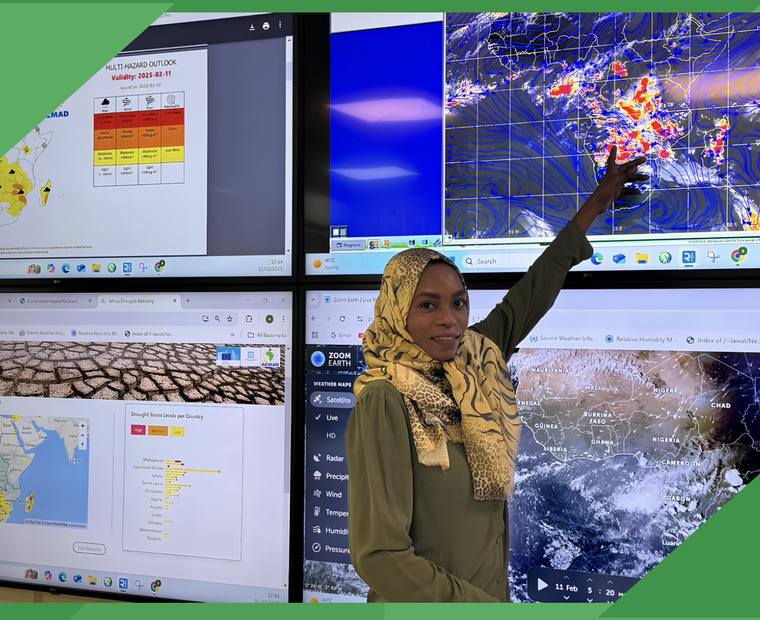
On-the-Job Training: junior to mid-career NMHS professionals.
Secondment: mid-career NMHS professionals and experts involved in WMO programmes.
Learning by doing
Access, visualise, interpret and evaluate NWP and climate-model outputs for operational forecasting and early warning.
Process CMIP and CORDEX datasets, develop scenarios and support vulnerability, risk and adaptation assessments.
Quality-control, homogenise, archive and manage climate data with tools such as CLIMSOFT.
Use global climate data, monitoring tools and ensemble techniques for seasonal and subseasonal forecasts.
Use satellite, radar and NWP products to track severe weather and issue timely warnings.
Combine hazard, exposure and vulnerability information to produce actionable sector-specific forecasts.
Build Linux, networking and WRF skills for high-resolution local forecasting.
Apply statistical and computational methods to large, high-resolution datasets and products.
Apply foundational AI techniques to forecasting, climate monitoring and data workflows.
Map and forecast climate-sensitive disease risks using historical and real-time information.
Install, operate and maintain stations, PUMA systems, networks and high-performance computing.
Understand climate-finance institutions and develop fundable climate project proposals.
Translate science into accessible information for television, digital media and public decision support.
Application pathway
Applications are coordinated through national services. Selection considers regional balance, gender equity and alignment with national priorities.
Begin with an official request through the appropriate Permanent Representative (PR) or National Meteorological and Hydrological Service.
Define the proposed training project and submit the nomination letter, CV, diplomas or certificates, and motivation letter requested by ACMAD.
After selection, ACMAD and the nominating institution agree and sign the training convention before travel and logistical arrangements are confirmed.
Knowledge returned home
Download reports prepared by visiting experts at the end of their placement.
Visitor reports will be published here as they are received.
Trainee voices
“This training provided essential skills in impact-focused seasonal forecasting. The expertise gained at ACMAD will improve anticipation and response to climate challenges, helping mitigate economic losses and support food security in the Union of the Comoros.”Miroirdine KamardineNMHS Comoros
“The combined training in weather prediction and communication sharpened my forecasting skills for extreme events and taught me to turn science into actionable, user-friendly information.”Esther ModiNMHS Cameroon
Programme moments
Photos and videos will be added from the dashboard.
Reach across the continent
| Country | Participants |
|---|---|
| Cameroon | 1 |
Plan your stay
Participants are hosted in Niamey. Current recommended accommodation, rates and contact information can be maintained here by the programme team.
Contact the programme team for current accommodation guidance in Niamey.